
Extreme heat changes how the body performs, reacts, and recovers at outdoor events.
This guide explains how misting fans help protect athletes, performers, and fans from heat-related illness.
You’ll find clear explanations, real-world use cases, and the science behind why misting fans cooling works for keep athletes, performers and fans safe from extreme heat.

Every summer brings headlines of athletes collapsing from heat exhaustion, outdoor concerts being canceled due to dangerous temperatures, and spectators requiring emergency medical attention at sporting events.
As global temperatures continue to rise and extreme heat events become more frequent and intense, the need for effective heat protection strategies has never been more critical.
For facility managers, event organizers, athletic trainers, and safety officials, the challenge is clear: how do you maintain safe conditions for athletes, performers, and spectators when the mercury soars?
The answer lies in understanding both the science of heat stress and the proven technology of evaporative cooling through misting fan systems. While heat-related illnesses continue to pose serious risks across all outdoor activities, research from the American College of Sports Medicine demonstrates that proper cooling interventions can dramatically reduce the incidence of heat-related emergencies.
Misting fans represent one of the most effective, practical, and cost-efficient solutions available for creating safe microclimates in otherwise dangerous heat conditions.
Be sure to visit our Miami misting fans and Phoenix misting fans pages. We are here for you. To keep you safe.
The statistics are sobering. Heat-related illness accounts for more deaths among high school athletes than all other causes combined, according to data from the University of Connecticut’s Korey Stringer Institute. Meanwhile, research from the University of Georgia shows that regional heat safety thresholds for athletics are being exceeded with increasing frequency across the United States, forcing cancellations and modifications of outdoor events at unprecedented rates.
The impact extends far beyond athletics. Music festivals, outdoor ceremonies, and community events. Face mounting pressure to provide adequate heat protection for participants and attendees.
The economic implications are substantial. Event cancellations due to heat can result in millions in lost revenue, while the legal and ethical obligations to provide safe environments continue to evolve. We must all work hard to keep everyone safe from extreme heat.
Traditional approaches to heat management. Shade structures, hydration stations, and air conditioning. While important, often prove insufficient during extreme heat events.
Shade provides relief from radiant heat but doesn’t address ambient temperature or humidity. Hydration helps maintain physiological function but cannot counteract the environmental heat load.
Air conditioning is effective but typically limited to indoor spaces and requires substantial infrastructure investment.
This is where evaporative cooling through misting fans emerges as a game-changing technology. Unlike passive cooling methods, misting fans actively reduce air temperature through the physics of evaporation, creating localized cool zones that can be deployed quickly and cost-effectively wherever they’re needed most.

The principle behind misting fan cooling is elegantly simple yet remarkably effective.
When water is atomized into microscopic droplets (typically 10-50 microns) and dispersed into moving air, the water undergoes rapid evaporation. This phase change from liquid to vapor absorbs substantial amounts of heat energy from the surrounding air—specifically, 2,260 kilojoules per kilogram of water evaporated.
Studies from the Technical University of Cluj-Napoca demonstrate that properly designed evaporative cooling systems can reduce air temperatures by 10-25°F (5.5-14°C) in suitable atmospheric conditions.
The effectiveness of this cooling process depends on several factors: ambient temperature, relative humidity, air movement, and the quality of the misting system itself. Unlike air conditioning, which works against humidity, evaporative cooling works best in hot, dry conditions. Precisely the environments that pose the greatest heat stress risk to athletes and spectators.
This comprehensive guide is designed for the diverse group of professionals responsible for heat safety across different venues and events:
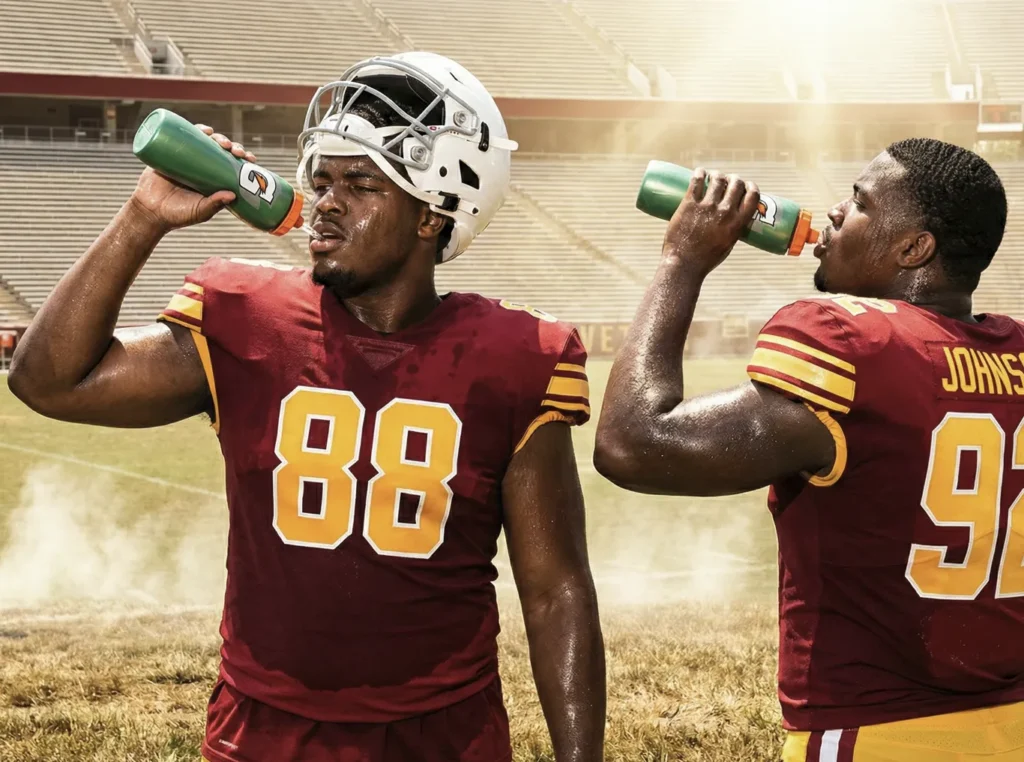
While numerous resources exist on general heat safety, this guide focuses specifically on misting fan technology as a comprehensive solution.
Drawing on cutting-edge research from institutions like the University of Roehampton and the University of Arkansas, we provide practical, implementable strategies backed by peer-reviewed science.
The guide moves beyond theoretical concepts to address real-world implementation challenges:
As climate change continues to drive more frequent and severe heat events, the organizations and individuals responsible for public safety must adapt their strategies accordingly.
Misting fan technology offers a proven, scalable solution that can be implemented across a wide range of venues and applications.
This guide will equip you with the knowledge to assess your specific needs, design appropriate cooling solutions, implement effective operational protocols, and maintain systems for optimal performance.
Whether you’re protecting high school athletes during summer practice. Ensuring spectator safety at outdoor venues. Or managing heat risks for performers and crew, the principles and practices outlined here will help you create safer environments for everyone under your care.
The stakes are too high for inadequate heat protection. Let’s explore how misting fan technology can become an essential component of your comprehensive heat safety strategy.
Human survival depends on maintaining core body temperature within a narrow range of 97-100°F (36.1-37.8°C). When environmental conditions challenge this thermal equilibrium, the body’s thermoregulatory system activates a complex cascade of physiological responses designed to preserve life-critical temperature balance.
Understanding these mechanisms is essential for anyone responsible for heat safety, as it provides the scientific foundation for effective cooling interventions.
The human heat balance equation is elegantly simple: Heat Production + Heat Gain = Heat Loss + Heat Storage.
When this equation becomes unbalanced. When heat gain and production exceed the body’s ability to dissipate heat. Core temperature begins to rise, triggering the progression toward heat-related illness.
The body employs four primary mechanisms for heat dissipation: radiation, conduction, convection, and evaporation. Under normal conditions, radiation accounts for approximately 60% of heat loss, as the body naturally radiates heat to cooler surrounding surfaces. Convection, the transfer of heat to moving air or water, typically contributes another 15-20%.
Conduction, direct heat transfer to contacted surfaces, plays a minimal role under most circumstances.
However, when ambient temperatures approach or exceed skin temperature (approximately 95°F/35°C), radiation and convection become ineffective or even counterproductive, as the body begins gaining heat from the environment rather than losing it.
At this critical threshold, research from the University of Connecticut demonstrates that evaporative cooling through sweating becomes the body’s primary. And eventually only. Mechanism for heat dissipation.
Sweating represents the body’s most powerful cooling mechanism, capable of dissipating up to 2,430 kilojoules of heat per liter of sweat evaporated. The average person can produce 1-3 liters of sweat per hour during intense activity in hot conditions, theoretically providing enormous cooling capacity.
However, several factors limit the effectiveness of this natural cooling system.
First, sweat must evaporate to provide cooling benefit. In high humidity conditions, the air’s reduced capacity to absorb additional water vapor severely impairs evaporation rates. When relative humidity exceeds 70%, sweat evaporation becomes significantly compromised, leading to the accumulation of sweat on the skin without corresponding cooling benefit.
Second, sweating capacity varies dramatically among individuals and becomes impaired as core temperature rises. Studies from the University of Canberra show that heat-acclimatized individuals can maintain higher sweat rates for longer periods, but even trained athletes experience declining sweat production as dehydration progresses and core temperature approaches dangerous levels.
Third, the electrolyte losses accompanying profuse sweating can impair both cooling capacity and overall physiological function. Sodium depletion affects the body’s ability to maintain blood volume and circulation, reducing the delivery of heated blood to the skin for cooling.

Heat-related illnesses exist on a continuum from mild heat stress to life-threatening heat stroke. Understanding this progression enables early recognition and intervention before conditions become critical.
Heat exhaustion represents the body’s signal that thermal regulation is becoming compromised. Characterized by profuse sweating, weakness, nausea, headache, and elevated core temperature (typically 100-104°F/37.8-40°C), heat exhaustion occurs when the cardiovascular system struggles to meet the competing demands of cooling and maintaining blood flow to vital organs.
The condition typically develops when fluid losses through sweating exceed replacement, leading to dehydration and reduced blood volume. As blood volume decreases, the heart must work harder to maintain circulation, while the body’s cooling capacity becomes progressively impaired.
Heat exhaustion serves as a critical warning sign. Individuals experiencing heat exhaustion are at significantly elevated risk for progression to heat stroke if cooling interventions are not immediately implemented.
Heat stroke represents complete failure of the thermoregulatory system and constitutes a true medical emergency with mortality rates ranging from 10-50% even with prompt medical treatment.
Defined by core body temperature exceeding 104°F (40°C) accompanied by central nervous system dysfunction, heat stroke can develop through two distinct pathways.
Classical heat stroke typically affects elderly individuals, young children, and those with chronic medical conditions during prolonged exposure to high environmental temperatures. The progression is usually gradual, occurring over hours or days of heat exposure.
Exertional heat stroke, more relevant to athletic and performance settings, can develop rapidly during intense physical activity, sometimes progressing from normal function to life-threatening condition in less than an hour.
The combination of internal heat production from exercise and environmental heat load overwhelms the body’s cooling capacity, leading to rapid core temperature escalation.
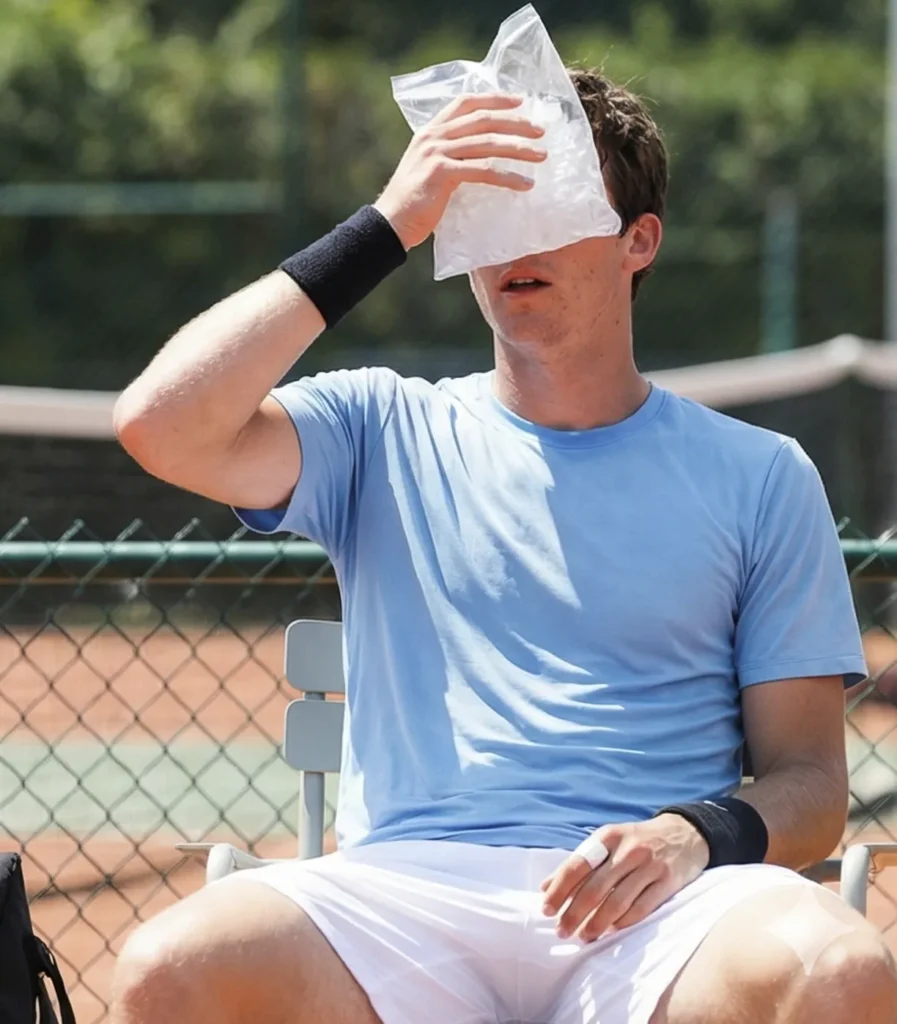
The neurological symptoms distinguishing heat stroke from heat exhaustion include confusion, agitation, delirium, and eventual loss of consciousness.
Paradoxically, sweating may be absent in heat stroke cases, as the thermoregulatory system has completely failed.
However, the presence of sweating does not rule out heat stroke, particularly in exertional cases where some cooling function may persist initially.
Heat cramps, while less immediately dangerous than heat exhaustion or stroke, indicate electrolyte imbalance and dehydration that can predispose individuals to more serious heat illness. These painful muscle spasms typically affect the calves, abdomen, and other heavily used muscle groups.
Heat syncope, the sudden loss of consciousness due to heat exposure, results from peripheral vasodilation and blood pooling in the extremities, reducing blood flow to the brain. While often brief and self-limiting, heat syncope can lead to serious injury if it occurs during athletic activity or in hazardous environments.
Certain groups face elevated heat illness risk due to physiological or circumstantial factors. Children have higher surface-area-to-body-mass ratios and less developed thermoregulatory systems, making them particularly vulnerable to rapid temperature changes.
Elderly individuals often have diminished cardiovascular function and may take medications that impair heat tolerance.
Athletes and performers face unique risks due to the combination of internal heat production from physical activity and potential environmental heat exposure.
The competitive nature of athletics can also lead to individuals pushing beyond safe physiological limits, ignoring early warning signs of heat stress.
Environmental conditions create the external heat load that challenges human thermoregulation. Understanding these factors enables accurate risk assessment and appropriate intervention timing.
While air temperature provides the most obvious heat stress indicator, humidity plays an equally critical role in determining heat illness risk. Regional heat safety thresholds that account for this temperature-humidity interaction, showing that humid heat poses greater physiological stress than dry heat at equivalent temperatures.
The heat index, which combines temperature and relative humidity into a single value representing “apparent temperature,” provides a more accurate assessment of heat stress risk than temperature alone. However, for athletic and occupational applications, the Wet Bulb Globe Temperature (WBGT) offers superior accuracy by incorporating the additional factors of radiant heat and air movement.
WBGT measurements account for the complex interactions between all environmental heat stress factors, providing precise guidance for activity modification decisions. When WBGT exceeds 82°F (28°C), most organizations recommend significant activity modifications or cancellations to prevent heat illness.

Radiant heat from sun exposure and hot surfaces can dramatically increase the total heat load on individuals, even when air temperature remains moderate. Artificial turf surfaces can reach temperatures of 150-180°F (65-82°C) during summer afternoons, while metal bleachers and concrete surfaces routinely exceed 120°F (49°C).
This radiant heat load is particularly problematic for athletes in direct contact with hot surfaces and for spectators in unshaded seating areas. The human body absorbs this radiant energy in addition to dealing with ambient air temperature and internal heat production from physical activity.
Air movement significantly affects heat stress by enhancing both convective and evaporative cooling. Even light air movement of 2-3 mph can provide substantial cooling benefit by facilitating sweat evaporation and convective heat transfer.
Conversely, still air conditions dramatically reduce the body’s cooling capacity.
Large venues often exhibit significant microclimate variations, with some areas experiencing substantially different heat stress conditions than others.
Understanding these patterns enables targeted cooling interventions in the highest-risk zones.
Heat stress risk varies significantly throughout the day and across seasons. Peak risk typically occurs during afternoon hours (2-6 PM) when air temperatures reach daily maximums and radiant heat load is highest. However, early season heat exposure can be particularly dangerous, as individuals have not yet developed heat acclimatization.
The timing of heat exposure relative to activity also matters significantly. Pre-cooling before activity can provide a substantial safety buffer, while post-activity cooling becomes critical for individuals whose core temperatures have become elevated during exercise.
Understanding the science of heat stress provides the foundation for effective cooling interventions. The key insights that inform misting fan deployment include:
These scientific principles demonstrate why misting fans represent such an effective heat safety tool. By enhancing evaporative cooling precisely when the body’s natural mechanisms become overwhelmed, misting fan systems provide critical thermal relief that can prevent the progression from heat stress to heat illness.
The next section will explore how misting fan technology leverages these physiological principles to create effective cooling solutions for athletes, performers, and spectators across diverse venue types and environmental conditions.
Thank you for checking in – we will bring you the next part of our how to keep athletes performers and fans safe from extreme heat with misting fans.
If you’re planning an outdoor event and heat safety matters. Please call us. We can keep your outdoor event safe.